How to Get Sales to Actually Use Your Content: A Playbook for Marketing & RevOps Teams

Growing up, I loved Tom & Jerry. It was always the same setup: two sides chasing different goals, occasionally aligned, usually tripping each other up.
Marketing and sales often look the same. In theory, they’re on the same team. But in practice, especially when it comes to sales enablement, they’re rarely moving in sync.
Sales enablement, at its core, is meant to equip sales teams with the content, tools, and insights they need to move deals forward, yet there’s still very little agreement on what actually drives adoption, and even less clarity on how to design content sales teams will use under pressure.
We know you aren’t alone in facing this challenge. So dive in as we break down why “good” sales content still gets ignored, what sales teams actually respond to, and the structural changes marketing and RevOps teams can make to build content that earns its place in the sales workflow
Why “good” sales content still doesn’t get used
Think about the times you have faced this:
- Shipped a polished deck only to watch reps recreate their own version a week later?
- Created new sales content assets that are gathering dust in a drive somewhere
- Poured hours into content that sits unused while reps ask, "Do we have something for this?"
Companies swear by sales enablement. They know it works ( sales enablement achieves a 49% win rate on forecasted deals, compared to 42.5% for those without it), yet they continue to sideline content built to support them. Whyyyyy?
The answer lies in the fact that while you're optimizing for brand consistency, your sales is optimizing for deal velocity. Simply put, while you're asking "Is this on-message and polished?" your sales reps are asking "Will this help me close this specific deal faster?"
In live deals, reps prioritize three things:
- Speed: Can I get this in front of my prospect today without rewriting half of it or waiting on approvals?
- Personalization: Can I adapt this to the prospect's industry or buying committee without breaking the whole template?
- Buyer engagement: Will this actually hold my prospect's attention or help them justify the decision internally?
When official content doesn't support those needs, reps don't escalate, but find ways to work around it. They rebuild "close enough" versions that feel faster and more relevant to the deal in front of them.
I reached out to our Head of Sales, Aaron Horton, to pressure-test this from the sales side. His answer was blunt and familiar to anyone who’s worked closely with reps.
“Sales teams love and appreciate the effort marketing puts into great, on-brand content. But we often think we know what will help us win a deal, so we create new content that’s ‘close enough’ to get out the door quickly and feel personalized for the prospect.”
You see the same thing playing out in public. In Reddit threads discussing sales enablement, reps don’t complain about a lack of content, but having too much of the wrong kind. Here’s an example: As you can see, reps are finding content that’s hard to adapt, disconnected from where the deal is, or simply not useful in the moment they need it.
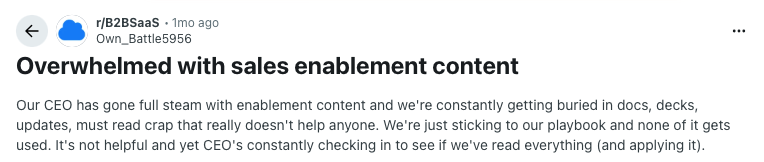
The takeaway is uncomfortable but important. Bottom line: Sales teams use content when it helps them advance a deal. When it doesn’t, they won’t, no matter how good it looks.
How to build content that sales will actually use
Now that we’ve unpacked why good sales content gets ignored, let’s get practical. The following changes focus on making content useful in the moments reps are trying to move a deal forward.
1. Aim at quality, not quantity
The most common mistake teams make is trying to build a comprehensive sales content library upfront. While it usually comes from a good place and you want sales to be supported across stages, personas, and use cases, in practice, this approach rarely matches how deals actually unfold.
The thing is that reps don’t need comprehensive coverage. What they need is help with the same questions and objections that come up again and again.
This is why starting narrow is more effective. When I spoke to Aaron, he explained that their library didn’t grow because marketing planned it that way. It grew because reps kept getting asked the same things by prospects.
“We started really narrow with our own templates and then waited for sales reps to ask for new content because they were being asked for it by their prospects. That’s how we built our library.”
The key shift here is learning how to tell the difference between a one-off request and a real demand signal.
Here’s a simple way to spot what’s actually worth building
Before you create a new piece of sales content, ask:
- Have multiple reps been asked for this in active deals?
- Does it come up after pricing or commercial discussion, not just discovery?
- Would a buyer reasonably want to share this internally?
- Are reps already creating their own version of it?
- Does this help remove friction or answer a repeated objection?
If the answer is yes to most of these, you’re not guessing. If not, you’ll be wasting efforts in creating content around hypothetical needs.
2. Design for the buying committee, not just the champion
Put yourself in a sales rep’s position for a moment.
You’ve just had a solid call with a champion. They get the problem, they like the solution, and they ask for “something to share internally.” You know what happens next. The deck gets forwarded to finance, legal scans it, and a senior leader glances at it between meetings. None of them were on the call. None of them has your context.
This is where most sales content breaks down…
Reps don’t avoid enablement content because it’s poorly designed or off-brand. They avoid it because it doesn’t survive that internal handoff. When content only works if the rep is there to explain it, champions are forced to translate, defend, and justify the decision on your behalf. That’s risky. And sales reps know it.
So they default to content that travels well.
That’s why proposals get shared while decks get skimmed. It’s why ROI summaries, pricing tables, and clear next steps outperform beautifully written positioning slides. Content gets adopted when it helps champions answer the questions they’re going to get asked next.
Some companies like Lambda, have been able use Qwilr’s capabilities with regard to the above successfully, as shared by Robert Brooks, Director of Sales
“It’s pretty common for us to have a champion in an organization doing some internal selling. The Qwilr page means they have everything they need to make their pitch and don’t have to reach back out to us to get more information."
If you want sales to adopt content, design it for that moment. Ask yourself:
- Could someone outside sales understand this without extra explanation?
- Would finance or legal have enough information to form an opinion?
- Does this help a champion justify the decision when you’re not in the room?
When reps see content that works not just for the champion but for the entire buying committee, adoption stops being a push and becomes the obvious choice.
3. Make personalization fast, not hard
Most organizations end up in one of two bad places.
In the first, marketing tightly controls sales content. Everything is on brand, but personalization requires requests, reviews, and time, sales simply doesn’t have.
In the second, sales moves fast and edits content themselves. Decks get duplicated, messaging drifts, and “close enough” versions circulate because speed matters more than perfection. You don’t want to be in either scenario.
Sales reps personalize because they have to. Prospects can immediately tell when something is generic, especially late in the buying cycle. Used well, AI can help reps personalize content faster at scale, and an AI checker can serve as a final review step to catch wording that still reads too broad or templated.
When official content slows reps down, they don’t bypass it out of disrespect for the brand, they do it to keep deals moving.
As Aaron says: “If you make them hyper personalized and they add value, you stand a better chance.”
That’s why many teams invest in proposal software like Qwilr, which offers modular content blocks, brand guardrails, and real-time editing, enabling swift personalization and allowing reps to tailor proposals on the fly without rebuilding them from scratch or drifting off-brand.

Teams like BELAY see this play out in practice. Nick Vian, IT Systems Administrator, shares:
“We serve a wide range of industries. Virtual assistants, bookkeepers, social media managers. Qwilr lets us effortlessly tailor proposals for each vertical without reinventing the wheel.”
When personalization is fast and safe, adoption stops being a fight. Sales uses the content because they were told to.
4. Integrate content into a system that sales actually uses every day
Most sales teams already have a content hub, created by Marketing…which they DO NOT USE.
It’s because it lives in a place that sales have to remember to visit. A separate portal or a shared drive and a beautifully organized hub feels useful in theory, but irrelevant in the middle of a live deal.
What does get used are systems tied directly to revenue work. The places reps already spend time creating, sending, and following up with buyers.
That’s why content management works best when it’s embedded inside the tools sales uses to move deals forward, not parked somewhere “off to the side.”
When reps can create a one-pager, pull in a case study, adjust pricing, or assemble a proposal without switching tools, content stops feeling like overhead.
This is where proposal-first platforms like Qwilr change the equation. Instead of acting as a static library, Qwilr functions as a central, sales-facing content system. Reps can build proposals, one-pagers, and case studies using approved content blocks, embed videos or product demos, tailor sections for different stakeholders, and reuse content across deals without starting from scratch.
Because everything lives in one place, reps don’t have to decide where to go for content. They just build what they need in the moment, using formats buyers are already willing to engage with.
That’s the difference between “please use the content hub” and actual adoption. When content lives inside a system sales already rely on to do their job, its usage becomes automatic.
5. Build a feedback loop for content, not a handoff
In sales enablement, you’ll see similar patterns recur. Marketing and RevOps teams involve sales early, gather input, build the content, launch it, and move on.
“Too often sales strategies, enablement, and content are created without input from those who have daily touch points with clients. This results in content that doesn't resonate with the sales team which ultimately sets the whole process up for failure. You need to have instant buy-in, if the content sounds like fluff it will fall on deaf ears.”
Colin Hugo, Sales Director
That’s usually where adoption breaks down. It’s because buyer objections shift, stakeholders change, and content that once felt useful quietly stops pulling its weight, and new deals with new objections begin to suffer.
So how can teams prevent this chaos? The answer is to gather regular feedback in a lightweight rhythm, not a big process. A monthly or quarterly check-in is usually enough. The goal isn’t to review every asset, but to understand what’s actually getting used.
In those check-ins, ask very specific questions:
- What content did you use in your last few deals?
- What did buyers respond to or comment on?
- What did you end up creating yourself because the existing content didn’t help?
You’ll start to see patterns quickly. The same few assets will come up again and again. Others won’t be mentioned at all. That’s your signal.
You can reinforce this in deal reviews, too. When reps walk through a closed-won or lost deal, ask which pieces of content were shared and why. Over time, this gives marketing and RevOps a clear view of what’s performing and what isn’t, ensuring you offer formats and content that are actually useful.
6. Train and onboard content like it's part of the sales motion
Most sales content doesn’t get ignored because it’s bad. It gets ignored because reps don’t know when to use it, why it matters, or how it fits into a live deal. So essentially, marketing ships content, announces it in Slack, maybe runs a 30-minute walkthrough, and calls it done. Then wonders why adoption is 15%.
Content needs to be onboarded the same way you onboard a new sales tactic. That means showing reps exactly when to use it, why it works, and proof that it actually closes deals.
Here are the steps that actually move the needle:
- Show the moment, not just the asset. Don't say "use this deck for discovery calls." Say "When a prospect asks about ROI in the first call, send them this personalized ROI page within 24 hours. Here's the template link, here's how to customize it in under 5 minutes."
- Share peer proof: If you've recorded a 2-minute Loom of a top rep explaining when they used the content and what happened, post it in the sales channel with the template link. Reps trust other reps more than they trust announcements from marketing. Let them see it working for someone like them.
- Make it absurdly easy to access: If a rep has to ask "Where's that thing again?" you've already lost. Pin the link in Slack. Add it to the CRM at the relevant pipeline stage. Send a clickable link, not instructions on how to navigate a folder structure.
- Track usage publicly (without shame): If you're sharing adoption stats in team meetings, frame them as wins: "23 reps used the pricing calculator this month, average deal velocity was 18% faster." Make using the content feel like being part of the winning strategy, not following orders.
One more thing is to train the managers first. If managers don't use the content themselves or can't explain when it works, reps won't adopt it—no matter how good your rollout is.
The fastest way to kill adoption is for managers to say, "This is the new thing from marketing" at kickoff, then tell reps, "Just do what you need to close the deal" in 1-on-1s.
Train managers separately before the team sees it; have them present it (not you); and ensure they can connect it to revenue impact, not just process compliance.
7. Build for different sellers and different buyers
Marketing typically builds one primary format—usually a deck or PDF—and assumes that works for everyone. But not all reps sell the same way, and not all buyers consume information the same way.
Some reps are great on video and love sending Loom walkthroughs. Others prefer clean one-pagers or data-heavy ROI calculators. On the buyer side, executives want quick summaries they can skim in 60 seconds. Analysts want detailed case studies they can dig into. Finance needs pricing breakdowns they can model.
When you only have one format available, reps are stuck. The buyer asks "Can you send a quick video?" and the rep either has to say no, scramble to create something, or send a 20-slide deck and hope for the best.
The fix is to build the same core message in multiple formats so reps can match their style and the buyer's preference in that moment.
What this looks like:
- Video: 2-minute product walkthrough for visual learners and busy executives
- One-pager: Scannable summary with key stats for quick decision-makers
- Interactive proposal: Full proposal with pricing, case studies, and ROI calculator for buying committees
- Detailed case study: In-depth proof for analysts and technical buyers
- Slide deck: Traditional format for live presentations
The format that matches what buyers actually need in that moment—concrete information to make a decision—gets used. The ones that require extra effort get skipped.
When a rep can send exactly what the buyer asked for, in the format they want, without creating it from scratch, content becomes useful instead of optional.
The mindset shift: Stop managing content, start enabling deals
Your job isn't to create content and hope sales uses it, but to build a system that removes friction from the selling process.
That's when you’ll see a transformation and not just adoption. Adoption means reps use your content because they're supposed to. Transformation means they use it because it's faster than making their own!
Before you create anything new, ask: "Does this make a rep's job easier in a specific selling moment, or does it just check a box for marketing?"
The best sales enablement content is invisible, and reps just reach for it because in the moment they need to send something, it's already the easiest option that does what they need.
Ready to build content that actually gets used?
Qwilr helps teams create interactive proposals, one-pagers, and sales content that's built for how reps actually sell—with modular blocks, real-time personalization, embedded pricing and ROI calculators, and analytics that show what buyers engage with.
Book a demo with our team, and we'll show you how to build content that transforms from "should use" to "just works."
About the author
Taru Bhargava|Content Strategist & Marketer
Taru is a content strategist and marketer with over 15 years of experience working with global startups, scale-ups, and agencies. Through taru&co., she combines her expert skills in content strategy, brand management, and SEO to drive more high-intent organic traffic for ambitious brands. When she’s not working, she’s busy raising two tiny dragons. She's on a first-name basis with Mindy Kaling.